Calibration
Optimization Overview
A generic material model  has parameters
  and
produces outputs (e.g., stress
and
produces outputs (e.g., stress  ) as a function inputs (e.g. strain
  ):
):
(5)
Calibration determines optimal parameters given: (a) experimental data and
(b) an objective that indicates how close the model is to the data.
The observable experimental data is rarely at the level of the
output of the model in (5) (e.g. stresses at points).
Instead, the model needs to be embedded in a simulator of a boundary
value problem (BVP) that emulates the experiment and gives the observables 
(6)
as a function of the experimental conditions/controls  (such as temperature or applied velocities)
which we call states.
The dependence of the quantities of interest
(such as temperature or applied velocities)
which we call states.
The dependence of the quantities of interest  on
the parameters comes via the dependence of the boundary value
problem on the selected model .
on
the parameters comes via the dependence of the boundary value
problem on the selected model .
The (calibration) objective compares the quantities of interest
with experimental data  .
Geometrically an objective can be thought of a distance, for example the mean squared error
.
Geometrically an objective can be thought of a distance, for example the mean squared error
(7)
where  is the L2-norm for functions or L2-norm for discrete data.
The difference
is the L2-norm for functions or L2-norm for discrete data.
The difference  is called the residual.
With the chosen objective
is called the residual.
With the chosen objective  , the calibration problem to find
the optimal parameters
, the calibration problem to find
the optimal parameters  becomes:
(8)
where the minimization can be accomplished by a variety of gradient and/or global optimization techniques.
A weighted least squares objective, such as
(9)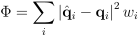
(here for the discrete data case), gives control over what data or features
in the data are emphasized in the calibration.
For instance, setting the weights  equal to measurement
noise variance for each point
equal to measurement
noise variance for each point  guides the fit to be closer
to data points with less uncertainty.
Alternately, a large weight for a particular point or set of points in
the experimental data can emphasize the importance of a feature such as yield.
Mixing residuals from different quantities of interest presents a scaling/conditioning
problem which can be handled by scaling the residuals for each dataset
guides the fit to be closer
to data points with less uncertainty.
Alternately, a large weight for a particular point or set of points in
the experimental data can emphasize the importance of a feature such as yield.
Mixing residuals from different quantities of interest presents a scaling/conditioning
problem which can be handled by scaling the residuals for each dataset  separately
(10)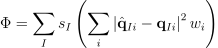
with a scale factor  per dataset so each residual is on par with the others.
A number of common issues complicate the calibration and are worth mentioning:
Noise in the data
Discrepancy between the model and the data (the model cannot fit the data perfectly)
Non-identifiability of the parameters (combinations of parameters produce identical output and/or the data is too simple to determine all the parameter uniquely)
These issues are investigated further in Introduction Examples where potential solutions to handling them are demonstrated. More details on specifics to optimization can be found in [17] and a book with relevance for using optimization for calibration and inverse problems is [30].