Advanced Examples
In this gallery of examples, we show how to use MatCal to perform calibration with real experimental data. MatCal has several calibration, uncertainty quantification and sensitivity study tools to use, and these examples demonstrate how to use them when applied to data from different materials. As the features are developed and documented more feature examples will be added here to highlight their use.
304L annealed bar viscoplastic calibrations
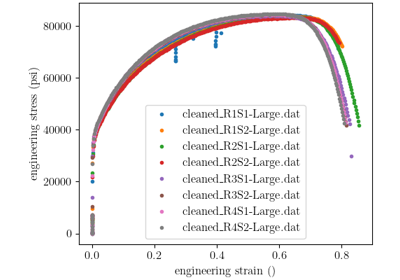
In this calibration example, we will calibrate a plasticity model using a rate dependent von Mises yield surface with Voce hardening [32] to the Ductile Failure data for 304L bar material [12]. The experimental data set used for this calibration was purposefully taken such that this viscoplastic behavior would be characterized.
This example has been broken into six steps:
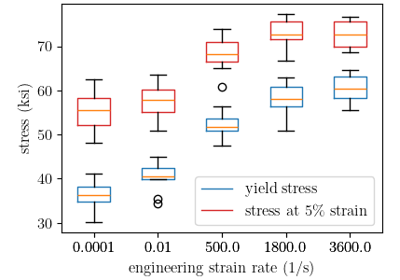
Experimental data analysis to aid in model form choice. 304L bar data analysis
Initial guess estimation for the plasticity parameters using MatFit. 304L bar calibration initial point estimation
Calibration of the material as the averaged parameter set to all data. 304L stainless steel viscoplastic calibration
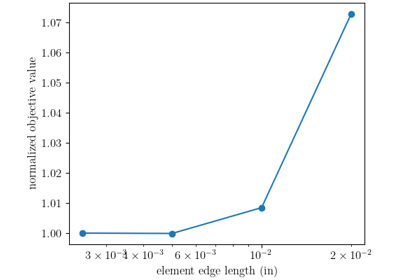
A mesh convergence study after the calibration to verify that the calibration is valid. 304L stainless steel mesh and time step convergence
A verification that the model options chosen for the calibration capture what is necessary for the model to be accurate. 304L calibrated round tension model - effect of different model options
Uncertainty quantification of the parameters using MatCal’s laplace study. 304L stainless steel viscoplastic calibration uncertainty quantification
Validation of the calculated parameter uncertainties by pushing samples from the uncertain parameter distributions back through the models and comparing the results to the experimental data. 304L stainless steel viscoplastic uncertainty quantification validation
304L stainless steel mesh and time step convergence
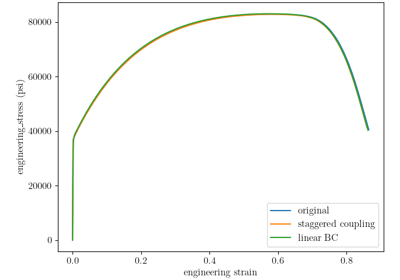
304L calibrated round tension model - effect of different model options
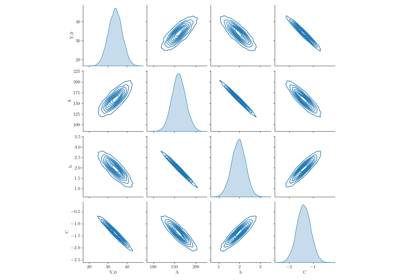
304L stainless steel viscoplastic calibration uncertainty quantification
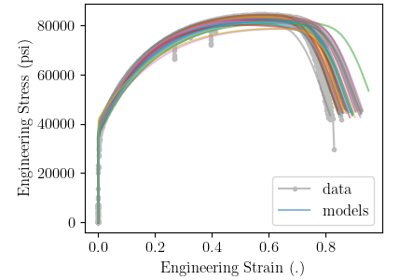
304L stainless steel viscoplastic uncertainty quantification validation
6061T6 aluminum plate calibrations
In this calibration example, we will calibrate the Hill48 orthotropic yield surface [8] with Voce hardening [32] to the Ductile Failure aluminum data for a rolled plate. The rolling process tends to impart a texture to the material microstructure that results in orthotropic plasticity behavior. The experimental data set used for this calibration was purposefully taken such that this orthotropic behavior would be characterized.
This example has been broken into several steps:
Experimental data analysis to verify the suspected orthotropic plasticity is present in the material. 6061T6 aluminum data analysis
Initial guess estimation for the plasticity parameters using MatFit and engineering judgment. 6061T6 aluminum anisotropy calibration initial point estimation
Calibration of the material as the averaged parameter set to all data. 6061T6 aluminum calibration with anisotropic yield
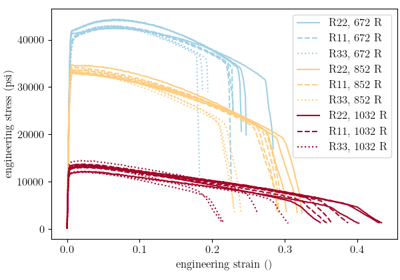
Data analysis to examine the effect of temperature on the material behavior and determine a material model form that is temperature dependent. 6061T6 aluminum temperature dependent data analysis
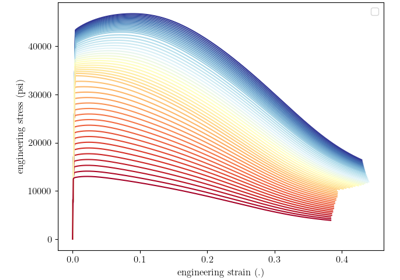
Initial point estimation using MatFit for the material model temperature dependence parameters. 6061T6 aluminum temperature calibration initial point estimation
Calibration of the material model temperature dependence using MatCal. 6061T6 aluminum temperature dependent calibration
Uncertainty quantification of the parameters using MatCal’s laplace study. 6061T6 aluminum calibration uncertainty quantification
Validation of the calculated parameter uncertainties by pushing samples from the uncertain parameter distributions back through the models and comparing the results to the experimental data. 6061T6 aluminum uncertainty quantification validation
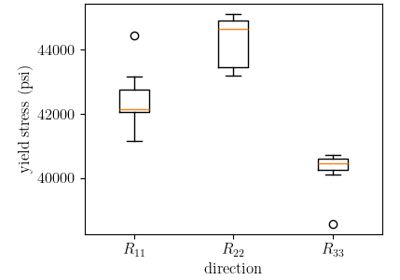
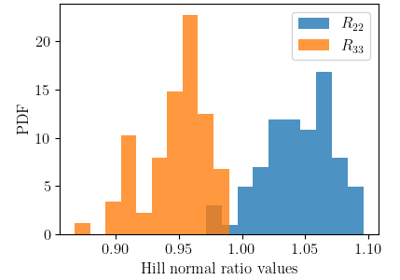
6061T6 aluminum anisotropy calibration initial point estimation
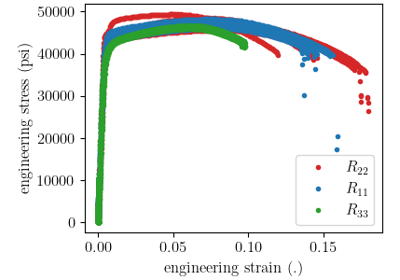
6061T6 aluminum calibration with anisotropic yield
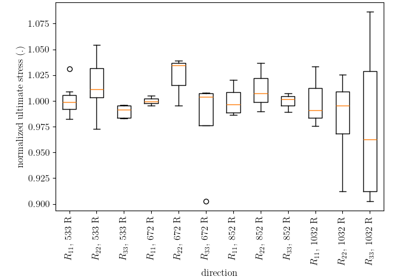
6061T6 aluminum temperature dependent data analysis
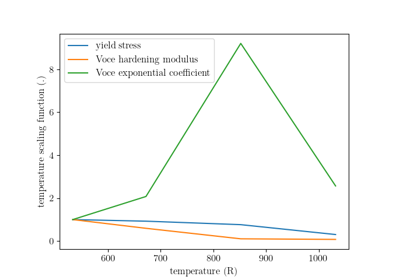
6061T6 aluminum temperature calibration initial point estimation
6061T6 aluminum temperature dependence verification
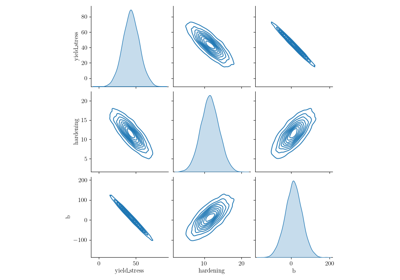
6061T6 aluminum calibration uncertainty quantification
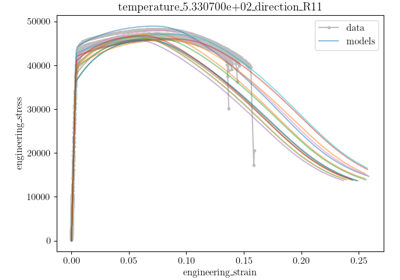
6061T6 aluminum uncertainty quantification validation
SIERRA User Defined Model Studies
In this example sub-gallery, we walk
through using the UserDefinedSierraModel
to perform MatCal studies. Careful model preparation is required
to ensure a successful study that behaves as expected.
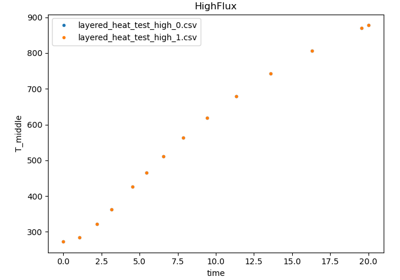
Calibration of Two Different Material Conductivities
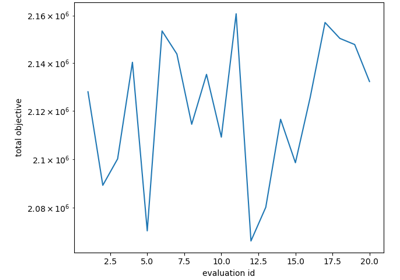
Latin Hypercube Sampling to Obtain Local Material Sensitivities