Note
Go to the end to download the full example code.
Virtual Fields Calibration Verification - Three Data Sets
In this example, we repeat the study performed
in Virtual Fields Calibration Verification one more time
but now include two additional data sets. We include the 90_degree
data set as described in Full-field Verification Problem Results,
and include a 45_degree data set. The 45_degree
data set was generated with
the material direction rotated 45 degrees away from
0_degree orientation about the Z axis. We believe this additional
data set will constrain the objective such that the best parameters
possible using the VFM method are found.
Since the problem setup and data manipulation is nearly identical to Virtual Fields Calibration Verification, we only add additional commentary and discussion on the study results at the end.
from matcal import *

state_0_degree = State("0_degree", angle=0)
synthetic_data_0 = FieldSeriesData("../../../docs_support_files/synthetic_surf_results_0_degree.e",
                                   state=state_0_degree)

state_45_degree = State("45_degree", angle=45)
synthetic_data_45 = FieldSeriesData("../../../docs_support_files/synthetic_surf_results_45_degree.e",
                                   state=state_45_degree)

state_90_degree = State("90_degree", angle=90)
synthetic_data_90 = FieldSeriesData("../../../docs_support_files/synthetic_surf_results_90_degree.e",
                                    state=state_90_degree)

dc = DataCollection("synthetic", synthetic_data_0, synthetic_data_45, synthetic_data_90)
import matplotlib.pyplot as plt
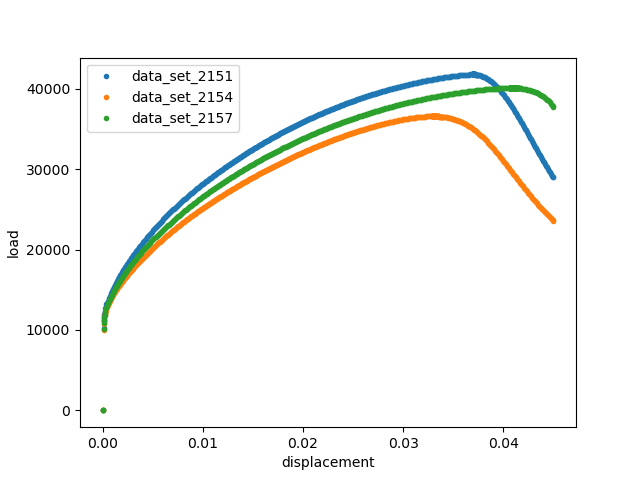
dc.plot("displacement", "load",figure=plt.figure())

dc["0_degree"][0] = synthetic_data_0[synthetic_data_0["displacement"] < 0.036]
dc["45_degree"][0] = synthetic_data_45[synthetic_data_45["displacement"] < 0.0325]
dc["90_degree"][0] = synthetic_data_90[synthetic_data_90["displacement"] < 0.040]

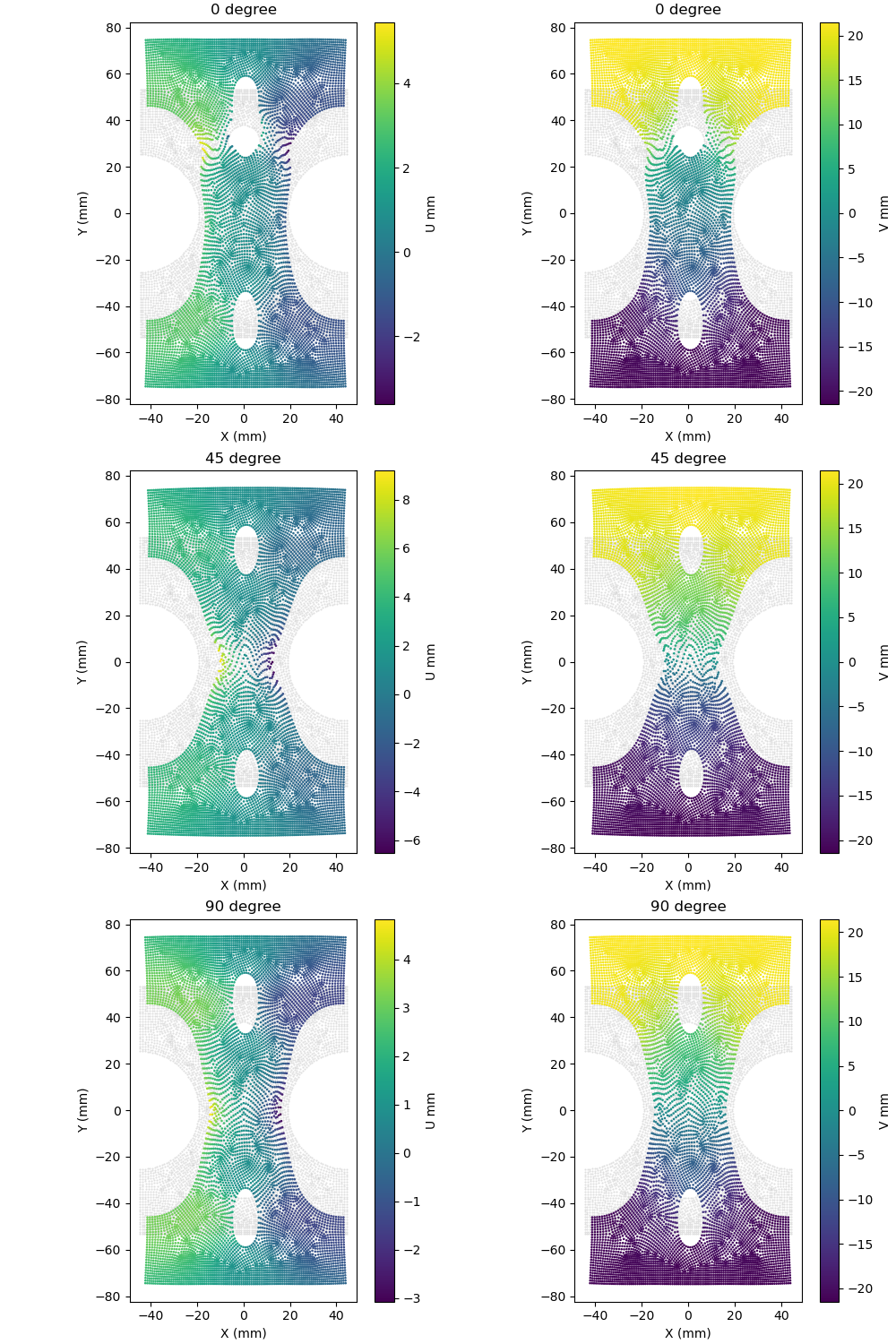
def plot_field(data, field, ax):
    c = ax.scatter(1e3*(data.spatial_coords[:,0]),
                   1e3*(data.spatial_coords[:,1]),
                   c="#bdbdbd", marker='.', s=1, alpha=0.5)
    c = ax.scatter(1e3*(data.spatial_coords[:,0]+data["U"][-1, :]),
                   1e3*(data.spatial_coords[:,1]+data["V"][-1, :]),
                   c=1e3*data[field][-1, :], marker='.', s=3)
    ax.set_xlabel("X (mm)")
    ax.set_ylabel("Y (mm)")
    direction = data.state.name.replace("_", " ")
    ax.set_title(f"{direction}")
    ax.set_aspect('equal')
    fig.colorbar(c, ax=ax, label=f"{field} mm")

fig, axes = plt.subplots(3,2, figsize=(10,15), constrained_layout=True)
plot_field(synthetic_data_0, "U", axes[0,0])
plot_field(synthetic_data_0, "V", axes[0,1])
plot_field(synthetic_data_45, "U", axes[1,0])
plot_field(synthetic_data_45, "V", axes[1,1])
plot_field(synthetic_data_90, "U", axes[2,0])
plot_field(synthetic_data_90, "V", axes[2,1])

plt.show()

mat_file_string = """begin material test_material
  density = 1
  begin parameters for model hill_plasticity
    youngs modulus  = {elastic_modulus*1e9}
    poissons ratio  = {poissons}
    yield_stress    = {yield_stress*1e6}

    hardening model = voce
    hardening modulus = {A*1e6}
    exponential coefficient = {n}

    R11 = {R11}
    R22 = {R22}
    R33 = {R33}
    R12 = {R12}
    R23 = {R23}
    R31 = {R31}

    coordinate system = rectangular_coordinate_system
    direction for rotation = 1
    alpha = 0
    second direction for rotation = 3
    second alpha = {angle}
  end
end
"""

with open("modular_plasticity.inc", 'w') as fn:
    fn.write(mat_file_string)

material = Material("test_material", "modular_plasticity.inc", "hill_plasticity")
vfm_model = VFMUniaxialTensionHexModel(material,
                                       "synthetic_data_files/test_mesh_surf.g",
                                       0.0625*0.0254)
vfm_model.add_boundary_condition_data(dc)
vfm_model.set_name("test_model")
vfm_model.set_number_of_cores(36)
vfm_model.set_number_of_time_steps(450)
vfm_model.set_displacement_field_names(x_displacement="U", y_displacement="V")
vfm_model.add_constants(elastic_modulus=200, poissons=0.27, R22=1.0,
                        R33=0.9, R23=1.0, R31=1.0)
from site_matcal.sandia.computing_platforms import is_sandia_cluster
from site_matcal.sandia.tests.utilities import MATCAL_WCID

if is_sandia_cluster():
    vfm_model.run_in_queue(MATCAL_WCID, 10.0/60.0)
    vfm_model.continue_when_simulation_fails()

vfm_objective = MechanicalVFMObjective()
vfm_objective.set_name("vfm_objective")

Y = Parameter("yield_stress", 100, 500.0)
A = Parameter("A", 100, 4000)
n = Parameter("n", 1, 10)
R11 = Parameter("R11", 0.8, 1.1)
R12 = Parameter("R12", 0.8, 1.1)

param_collection = ParameterCollection("hill voce", Y, A, n, R11, R12)

study = GradientCalibrationStudy(param_collection)
study.set_results_storage_options(results_save_frequency=len(param_collection)+1)
study.set_core_limit(48)
study.add_evaluation_set( vfm_model, vfm_objective, dc)
study.do_not_save_evaluation_cache()
study.set_working_directory("vfm_three_angles", remove_existing=True)

results = study.launch()

calibrated_params = results.best.to_dict()
print(calibrated_params)

goal_results = {"yield_stress":200,
                "A":1500,
                "n":2,
                "R11":0.95,
                "R12":0.85}

def pe(result, goal):
    return (result-goal)/goal*100

for param in goal_results.keys():
    print(f"Parameter {param} error: {pe(calibrated_params[param], goal_results[param])}")
Opening exodus file: ../../../docs_support_files/synthetic_surf_results_0_degree.e
Opening exodus file: ../../../docs_support_files/synthetic_surf_results_0_degree.e
Closing exodus file: ../../../docs_support_files/synthetic_surf_results_0_degree.e
Closing exodus file: ../../../docs_support_files/synthetic_surf_results_0_degree.e
Opening exodus file: ../../../docs_support_files/synthetic_surf_results_45_degree.e
Opening exodus file: ../../../docs_support_files/synthetic_surf_results_45_degree.e
Closing exodus file: ../../../docs_support_files/synthetic_surf_results_45_degree.e
Closing exodus file: ../../../docs_support_files/synthetic_surf_results_45_degree.e
Opening exodus file: ../../../docs_support_files/synthetic_surf_results_90_degree.e
Opening exodus file: ../../../docs_support_files/synthetic_surf_results_90_degree.e
Closing exodus file: ../../../docs_support_files/synthetic_surf_results_90_degree.e
Closing exodus file: ../../../docs_support_files/synthetic_surf_results_90_degree.e
/gpfs/knkarls/projects/matcal-stable/external_matcal/matcal/core/data.py:572: UserWarning: Ignoring specified arguments in this call because figure with num: 1 already exists
  plt.figure(figure.number, constrained_layout=True)
Opening exodus file: synthetic_data_files/test_mesh_surf.g
Closing exodus file: synthetic_data_files/test_mesh_surf.g
Opening exodus file: matcal_template/test_model/0_degree/test_model.g
Closing exodus file: matcal_template/test_model/0_degree/test_model.g
Opening exodus file: matcal_template/test_model/0_degree/test_model.g
Closing exodus file: matcal_template/test_model/0_degree/test_model.g
Opening exodus file: matcal_template/test_model/0_degree/test_model.g
Closing exodus file: matcal_template/test_model/0_degree/test_model.g
Opening exodus file: matcal_template/test_model/0_degree/test_model.g
Opening exodus file: matcal_template/test_model/0_degree/test_model_exploded.g
Closing exodus file: matcal_template/test_model/0_degree/test_model_exploded.g
Closing exodus file: matcal_template/test_model/0_degree/test_model.g
Opening exodus file: matcal_template/test_model/45_degree/test_model.g
Closing exodus file: matcal_template/test_model/45_degree/test_model.g
Opening exodus file: matcal_template/test_model/45_degree/test_model.g
Closing exodus file: matcal_template/test_model/45_degree/test_model.g
Opening exodus file: matcal_template/test_model/45_degree/test_model.g
Closing exodus file: matcal_template/test_model/45_degree/test_model.g
Opening exodus file: matcal_template/test_model/45_degree/test_model.g
Opening exodus file: matcal_template/test_model/45_degree/test_model_exploded.g
Closing exodus file: matcal_template/test_model/45_degree/test_model_exploded.g
Closing exodus file: matcal_template/test_model/45_degree/test_model.g
Opening exodus file: matcal_template/test_model/90_degree/test_model.g
Closing exodus file: matcal_template/test_model/90_degree/test_model.g
Opening exodus file: matcal_template/test_model/90_degree/test_model.g
Closing exodus file: matcal_template/test_model/90_degree/test_model.g
Opening exodus file: matcal_template/test_model/90_degree/test_model.g
Closing exodus file: matcal_template/test_model/90_degree/test_model.g
Opening exodus file: matcal_template/test_model/90_degree/test_model.g
Opening exodus file: matcal_template/test_model/90_degree/test_model_exploded.g
Closing exodus file: matcal_template/test_model/90_degree/test_model_exploded.g
Closing exodus file: matcal_template/test_model/90_degree/test_model.g
OrderedDict({'yield_stress': 198.09838152, 'A': 1449.0675242, 'n': 2.0907659416, 'R11': 0.95015067647, 'R12': 0.8513227374})
Parameter yield_stress error: -0.950809239999998
Parameter A error: -3.3954983866666675
Parameter n error: 4.538297079999998
Parameter R11 error: 0.01586068105263154
Parameter R12 error: 0.15561616470588188
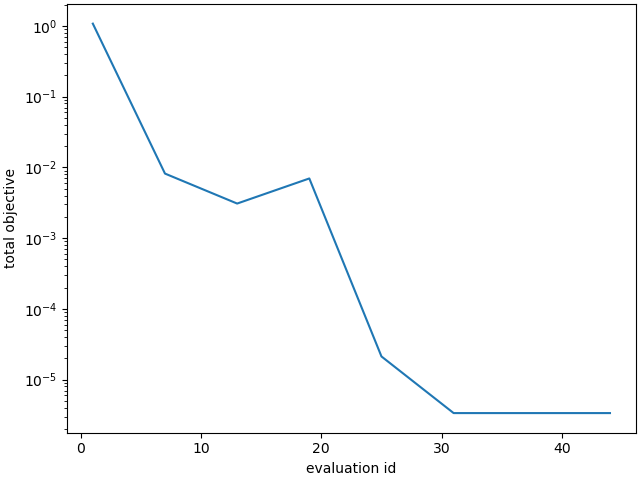
This calibration also completes
with RELATIVE FUNCTION CONVERGENCE
indicating the algorithm found a local
minima and based on our objective
sensitivity study it is likely a global minimum
for the VFM objective and model.
Additionally, all yield related parameters are
identified within 1% error. However,
The hardening parameters have up to 5%
error. This is due to the model form error
and correlation of these parameters. They
are negatively correlated so the  decreased approximately 4% while the
  increased approximately 5%. These changes
are relatively minor and are due to the model
form error introduced by the plane stress
assumption. Overall the results indicate
the VFM problem is well formulated for gradient
methods and can provide adequate calibrations
if over fitting is avoided.
increased approximately 5%. These changes
are relatively minor and are due to the model
form error introduced by the plane stress
assumption. Overall the results indicate
the VFM problem is well formulated for gradient
methods and can provide adequate calibrations
if over fitting is avoided.
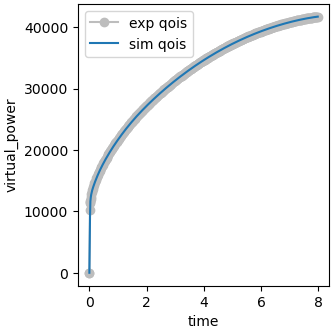
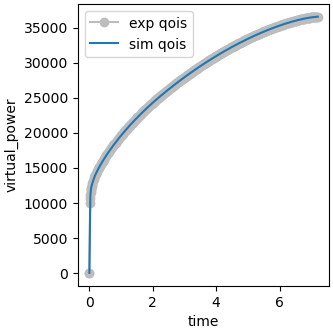
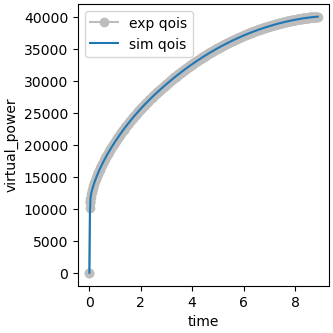
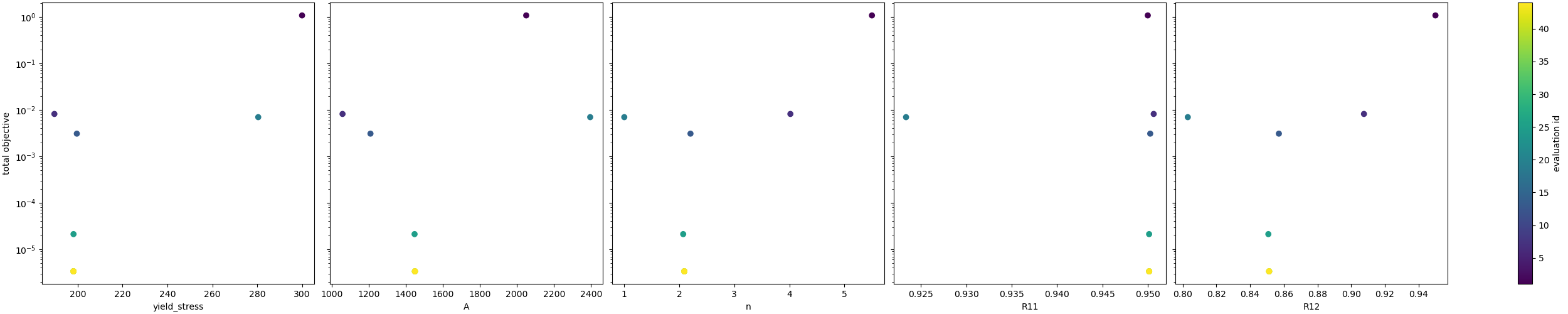
When we plot the results, we now see that all yield parameters are identified quickly with clear minima. The objective verses hardening parameters plots show evidence of a slight trough in the objective for these parameters. This is indicating some over fitting of these parameters is occurring due to the model form error introduced due to VFM’s plane stress assumption constrain.
import os
init_dir = os.getcwd()
os.chdir("vfm_three_angles")
make_standard_plots("time")
os.chdir(init_dir)

# sphinx_gallery_thumbnail_number = 2
Total running time of the script: (152 minutes 47.502 seconds)