Note
Go to the end to download the full example code.
6061T6 aluminum temperature dependence verification
In this example, we verify our calibrated temperature dependence functions do not produce unwanted behavior between the temperatures at which they were calibrated.
We will perform this verification by running the model at
many temperatures over our temperature range and inspecting the results.
To do this, we will generate fictitious boundary condition data at
all temperatures of interest with independent states. As with the calibrations
in this example suite, these data will have state variables of
temperature and direction. We will then run a
ParameterStudy with
the appropriate
RoundUniaxialTensionModel
in the evaluation set. The study will run a single evaluation
with parameter values from the results of
6061T6 aluminum temperature dependent calibration
and
6061T6 aluminum calibration with anisotropic yield.
Once all states are complete, we will plot the result and
visually inspect the curves to verify the behavior is as desired.
Once again, we begin by importing the tools needed for the calibration and setting our default plotting options.
from matcal import *
from site_matcal.sandia.computing_platforms import is_sandia_cluster, get_sandia_computing_platform
from site_matcal.sandia.tests.utilities import MATCAL_WCID

import numpy as np
import matplotlib.pyplot as plt
from matplotlib import cm

plt.rc('text', usetex=True)
plt.rc('font', family='serif')
plt.rc('font', size=12)
figsize = (4,3)
Next, we create our fictitious data using NumPy and
the MatCal convert_dictionary_to_data() function.
We want to sample the material model at many
temperatures over our temperature range and
choose to run the model from 533 to 1033 R in
intervals of 10 R. We create a data set
for each temperature that strains the material
to an engineering strain of approximately 0.3
and has zero values for engineering stress.
The stress values will not be used but are required
for the evaluation set. We only create states for the  direction since the other directions will have similar
responses.
direction since the other directions will have similar
responses.
temps = np.linspace(533.0, 1033.0, 51)
bc_data = DataCollection("bc data")
for temp in temps:
    state = State(f"temperature_{temp}", temperature=temp, direction="R11")
    data =  convert_dictionary_to_data({"engineering_strain":[0.0, 0.3],
                                        "engineering_stress":[0.0, 0.0]})
    data.set_state(state)
    bc_data.add(data)
With the fictitious boundary condition data created,
we create the RoundUniaxialTensionModel
as we did in 6061T6 aluminum temperature dependent calibration
and add the DataCollection that we created
as the model model boundary condition data.
material_filename = "hill_plasticity_temperature_dependent.inc"
material_model = "hill_plasticity"
material_name = "ductile_failure_6061T6"
sierra_material = Material(material_name, material_filename, material_model)

gauge_radius = 0.125
element_size = gauge_radius/8
geo_params = {"extensometer_length": 0.5,
               "gauge_length": 0.75,
               "gauge_radius": gauge_radius,
               "grip_radius": 0.25,
               "total_length": 3.2,
               "fillet_radius": 0.25,
               "taper": 0.0015,
               "necking_region":0.375,
               "element_size": element_size,
               "mesh_method":3,
               "grip_contact_length":0.8}

model = RoundUniaxialTensionModel(sierra_material, **geo_params)
model.set_name("tension_model")
model.add_boundary_condition_data(bc_data)
model.set_allowable_load_drop_factor(0.70)

if is_sandia_cluster():
    platform = get_sandia_computing_platform()
    model.set_number_of_cores(platform.get_processors_per_node())
    model.run_in_queue(MATCAL_WCID, 0.5)
    model.continue_when_simulation_fails()
else:
    model.set_number_of_cores(8)
We now create our parameters for our parameter study. The parameters are the parameters from 6061T6 aluminum temperature dependent calibration and 6061T6 aluminum calibration with anisotropic yield with their current value set to their calibration values.
RT_calibrated_params = matcal_load("anisotropy_parameters.serialized")

yield_stress = Parameter("yield_stress", 15, 50,
                         RT_calibrated_params["yield_stress"])
hardening = Parameter("hardening", 0, 60,
        RT_calibrated_params["hardening"])
b = Parameter("b", 10, 40,
        RT_calibrated_params["b"])
R22 = Parameter("R22", 0.8, 1.15,
        RT_calibrated_params["R22"])
R33 = Parameter("R33", 0.8, 1.15,
        RT_calibrated_params["R33"])
R12 = Parameter("R12", 0.8, 1.15,
        RT_calibrated_params["R12"])
R23 = Parameter("R23", 0.8, 1.15,
        RT_calibrated_params["R23"])
R31 = Parameter("R31", 0.8, 1.15,
        RT_calibrated_params["R31"])

high_temp_calibrated_params = matcal_load("temperature_dependent_parameters.serialized")

y_scale_factor_672_calibrated = high_temp_calibrated_params["Y_scale_factor_672"]
y_scale_factor_852_calibrated = high_temp_calibrated_params["Y_scale_factor_852"]
y_scale_factor_1032_calibrated = high_temp_calibrated_params["Y_scale_factor_1032"]

Y_scale_factor_672  = Parameter("Y_scale_factor_672", 0.85, 1,
                                y_scale_factor_672_calibrated)
Y_scale_factor_852  = Parameter("Y_scale_factor_852", 0.45, 0.85,
                                y_scale_factor_852_calibrated)
Y_scale_factor_1032 = Parameter("Y_scale_factor_1032", 0.05, 0.45,
                                y_scale_factor_1032_calibrated)

A_scale_factor_672_calibrated = high_temp_calibrated_params["A_scale_factor_672"]
A_scale_factor_852_calibrated = high_temp_calibrated_params["A_scale_factor_852"]
A_scale_factor_1032_calibrated = high_temp_calibrated_params["A_scale_factor_1032"]

A_scale_factor_672  = Parameter("A_scale_factor_672", 0.0,
                                2*A_scale_factor_672_calibrated)
A_scale_factor_852  = Parameter("A_scale_factor_852", 0.0,
                                2*A_scale_factor_852_calibrated)
A_scale_factor_1032 = Parameter("A_scale_factor_1032", 0.0,
                                2*A_scale_factor_1032_calibrated)

b_scale_factor_672_calibrated = high_temp_calibrated_params["b_scale_factor_672"]
b_scale_factor_852_calibrated = high_temp_calibrated_params["b_scale_factor_852"]
b_scale_factor_1032_calibrated = high_temp_calibrated_params["b_scale_factor_1032"]

b_scale_factor_672  = Parameter("b_scale_factor_672", 0.0,
                                3*b_scale_factor_672_calibrated,
                                b_scale_factor_672_calibrated)
b_scale_factor_852  = Parameter("b_scale_factor_852", 0.0,
                                3*b_scale_factor_852_calibrated,
                                b_scale_factor_852_calibrated)
b_scale_factor_1032 = Parameter("b_scale_factor_1032", 0.0,
                                3*b_scale_factor_1032_calibrated,
                                b_scale_factor_1032_calibrated)
To simplify setting up the parameter study,
we put all the parameters in a ParameterCollection.
pc = ParameterCollection("all_params",
                         yield_stress,
                         hardening,
                         b,
                         R22,
                         R33,
                         R12,
                         R23,
                         R31,
                         Y_scale_factor_672,
                         A_scale_factor_672,
                         b_scale_factor_672,
                         Y_scale_factor_852,
                         A_scale_factor_852,
                         b_scale_factor_852,
                         Y_scale_factor_1032,
                         A_scale_factor_1032,
                         b_scale_factor_1032)
Now we can create our parameter study and add an evaluation set. An objective is required, but will not be used for this example except for results access by name when the study is complete.
study = ParameterStudy(pc)
study.set_core_limit(60)
obj = CurveBasedInterpolatedObjective("engineering_strain", "engineering_stress")
obj.set_name('objective')
study.add_evaluation_set(model, obj, bc_data)
Parameter studies require the user to set parameter sets to be evaluated and will not run the parameter current values by default. As a result, we pass the current values from our parameter collection as a parameter set to be evaluated and then run the study.
study.add_parameter_evaluation(**pc.get_current_value_dict())
results = study.launch()
When the study finishes, we retrieve the simulation results
sim_dc = results.simulation_history[model.name]
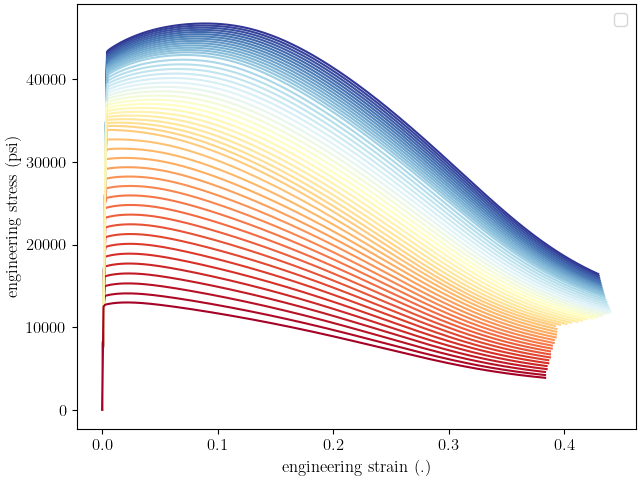
We then can plot the results
using plot()
and color the results according to temperature
as was done in 6061T6 aluminum temperature dependent calibration.
cmap = cm.get_cmap("RdYlBu")
def get_colors(data_dc):
    colors = {}
    for state_name in data_dc.state_names:
        temp = data_dc.states[state_name]["temperature"]
        colors[temp] = cmap(1.0-(temp-533.0)/(1032.0-533.0))
    return colors
colors = get_colors(sim_dc)

fig = plt.figure(constrained_layout=True)
for state_name in sim_dc.state_names:
    state = sim_dc.states[state_name]
    temperature = state["temperature"]
    sim_dc.plot("engineering_strain", "engineering_stress", labels="suppress",
                state=state, color=colors[temperature], show=False, figure=fig,
                linestyle="-")
plt.xlabel("engineering strain (.)")
plt.ylabel("engineering stress (psi)")

plt.show()
/gpfs/knkarls/projects/matcal-stable/external_matcal/documentation/advanced_examples/6061T6_anisotropic_calibration/plot_6061T6_g_temperature_dependent_verification_cluster.py:227: MatplotlibDeprecationWarning: The get_cmap function was deprecated in Matplotlib 3.7 and will be removed two minor releases later. Use ``matplotlib.colormaps[name]`` or ``matplotlib.colormaps.get_cmap(obj)`` instead.
  cmap = cm.get_cmap("RdYlBu")
No artists with labels found to put in legend.  Note that artists whose label start with an underscore are ignored when legend() is called with no argument.
No artists with labels found to put in legend.  Note that artists whose label start with an underscore are ignored when legend() is called with no argument.
No artists with labels found to put in legend.  Note that artists whose label start with an underscore are ignored when legend() is called with no argument.
No artists with labels found to put in legend.  Note that artists whose label start with an underscore are ignored when legend() is called with no argument.
No artists with labels found to put in legend.  Note that artists whose label start with an underscore are ignored when legend() is called with no argument.
No artists with labels found to put in legend.  Note that artists whose label start with an underscore are ignored when legend() is called with no argument.
No artists with labels found to put in legend.  Note that artists whose label start with an underscore are ignored when legend() is called with no argument.
No artists with labels found to put in legend.  Note that artists whose label start with an underscore are ignored when legend() is called with no argument.
No artists with labels found to put in legend.  Note that artists whose label start with an underscore are ignored when legend() is called with no argument.
No artists with labels found to put in legend.  Note that artists whose label start with an underscore are ignored when legend() is called with no argument.
No artists with labels found to put in legend.  Note that artists whose label start with an underscore are ignored when legend() is called with no argument.
No artists with labels found to put in legend.  Note that artists whose label start with an underscore are ignored when legend() is called with no argument.
No artists with labels found to put in legend.  Note that artists whose label start with an underscore are ignored when legend() is called with no argument.
No artists with labels found to put in legend.  Note that artists whose label start with an underscore are ignored when legend() is called with no argument.
No artists with labels found to put in legend.  Note that artists whose label start with an underscore are ignored when legend() is called with no argument.
No artists with labels found to put in legend.  Note that artists whose label start with an underscore are ignored when legend() is called with no argument.
No artists with labels found to put in legend.  Note that artists whose label start with an underscore are ignored when legend() is called with no argument.
No artists with labels found to put in legend.  Note that artists whose label start with an underscore are ignored when legend() is called with no argument.
No artists with labels found to put in legend.  Note that artists whose label start with an underscore are ignored when legend() is called with no argument.
No artists with labels found to put in legend.  Note that artists whose label start with an underscore are ignored when legend() is called with no argument.
No artists with labels found to put in legend.  Note that artists whose label start with an underscore are ignored when legend() is called with no argument.
No artists with labels found to put in legend.  Note that artists whose label start with an underscore are ignored when legend() is called with no argument.
No artists with labels found to put in legend.  Note that artists whose label start with an underscore are ignored when legend() is called with no argument.
No artists with labels found to put in legend.  Note that artists whose label start with an underscore are ignored when legend() is called with no argument.
No artists with labels found to put in legend.  Note that artists whose label start with an underscore are ignored when legend() is called with no argument.
No artists with labels found to put in legend.  Note that artists whose label start with an underscore are ignored when legend() is called with no argument.
No artists with labels found to put in legend.  Note that artists whose label start with an underscore are ignored when legend() is called with no argument.
No artists with labels found to put in legend.  Note that artists whose label start with an underscore are ignored when legend() is called with no argument.
No artists with labels found to put in legend.  Note that artists whose label start with an underscore are ignored when legend() is called with no argument.
No artists with labels found to put in legend.  Note that artists whose label start with an underscore are ignored when legend() is called with no argument.
No artists with labels found to put in legend.  Note that artists whose label start with an underscore are ignored when legend() is called with no argument.
No artists with labels found to put in legend.  Note that artists whose label start with an underscore are ignored when legend() is called with no argument.
No artists with labels found to put in legend.  Note that artists whose label start with an underscore are ignored when legend() is called with no argument.
No artists with labels found to put in legend.  Note that artists whose label start with an underscore are ignored when legend() is called with no argument.
No artists with labels found to put in legend.  Note that artists whose label start with an underscore are ignored when legend() is called with no argument.
No artists with labels found to put in legend.  Note that artists whose label start with an underscore are ignored when legend() is called with no argument.
No artists with labels found to put in legend.  Note that artists whose label start with an underscore are ignored when legend() is called with no argument.
No artists with labels found to put in legend.  Note that artists whose label start with an underscore are ignored when legend() is called with no argument.
No artists with labels found to put in legend.  Note that artists whose label start with an underscore are ignored when legend() is called with no argument.
No artists with labels found to put in legend.  Note that artists whose label start with an underscore are ignored when legend() is called with no argument.
No artists with labels found to put in legend.  Note that artists whose label start with an underscore are ignored when legend() is called with no argument.
No artists with labels found to put in legend.  Note that artists whose label start with an underscore are ignored when legend() is called with no argument.
No artists with labels found to put in legend.  Note that artists whose label start with an underscore are ignored when legend() is called with no argument.
No artists with labels found to put in legend.  Note that artists whose label start with an underscore are ignored when legend() is called with no argument.
No artists with labels found to put in legend.  Note that artists whose label start with an underscore are ignored when legend() is called with no argument.
No artists with labels found to put in legend.  Note that artists whose label start with an underscore are ignored when legend() is called with no argument.
No artists with labels found to put in legend.  Note that artists whose label start with an underscore are ignored when legend() is called with no argument.
No artists with labels found to put in legend.  Note that artists whose label start with an underscore are ignored when legend() is called with no argument.
No artists with labels found to put in legend.  Note that artists whose label start with an underscore are ignored when legend() is called with no argument.
No artists with labels found to put in legend.  Note that artists whose label start with an underscore are ignored when legend() is called with no argument.
No artists with labels found to put in legend.  Note that artists whose label start with an underscore are ignored when legend() is called with no argument.
As can be seen in the plot, the curves at the different temperatures do not cross which would result if the material was stronger at a higher temperature than some lower temperature. Since the results do not exhibit this crossing behavior, the fit is acceptable. Although, this is not a rigorous check to ensure the material is always weaker at lower temperatures, it is enough to provide some confidence that the fit is useable for most circumstances.
Total running time of the script: (7 minutes 58.263 seconds)